Inventory: know what you have, what you used and what to order
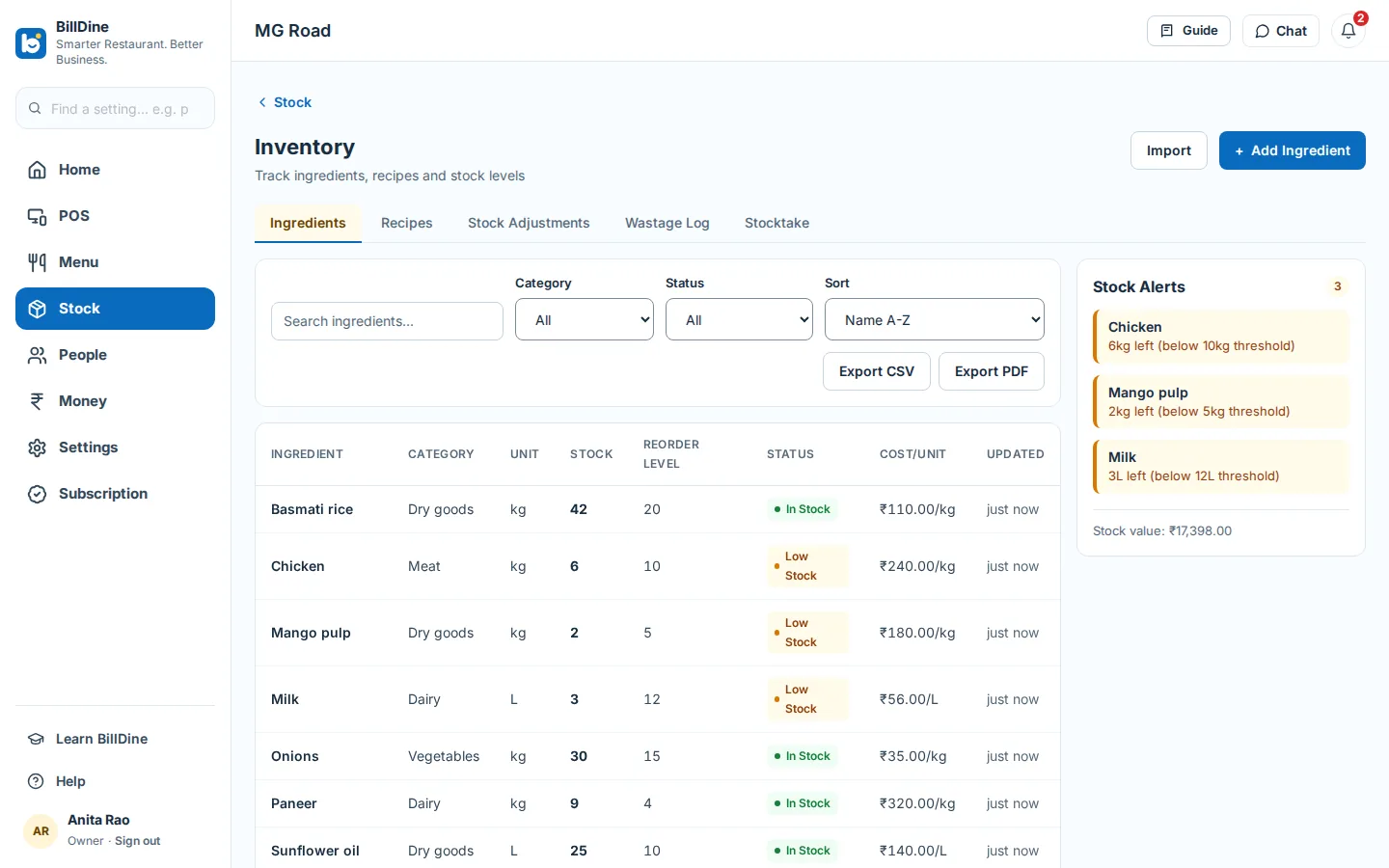
Your ingredients and stock levels
Stock → Inventory lists every ingredient an outlet keeps, with its stock, its reorder level, its status — In stock, Low stock or Out of stock — and its cost per unit. Low and empty ingredients are gathered under Stock alerts, with the stock's total value below them, so the morning check takes a glance rather than a walk round the store room.
Each ingredient has a stock unit — kilograms, grams, litres, millilitres or pieces — and you can add pack units, such as a bag or a crate, so deliveries are entered the way they arrive. Opening stock can be recorded with its cost, one ingredient at a time or for all of them at once, and a whole list of ingredients can be imported from a spreadsheet file.
Recipes take stock down as you sell
A recipe says what one portion of a dish or an add-on takes from stock: the ingredients, how much of each, and an optional wastage percentage for what is lost in cleaning or cooking. From then on, every kitchen ticket takes those ingredients out of the outlet's stock by itself. Nobody has to subtract anything at the end of the night.
While you write a recipe, BillDine shows the cost per portion and the food cost as a share of the dish's price, worked out from the average cost of your stock. Things you make in-house — a sauce, a spice mix, a dough — can be prepared items with recipes of their own. Cook them in batches and record each batch: its ingredients leave stock, the prepared item goes in, and a sale then takes the prepared item instead of its raw ingredients.
Wastage, corrections and stocktakes
Food thrown away goes in the Wastage log with a reason: spoiled, damaged, expired, over-prepared, spilled or another reason. A count that was simply wrong is fixed with a stock adjustment, with its own reason. A stocktake gives you a count sheet for the whole store; type what is on the shelf, and completing the count posts every difference at once. A blind count hides what the books say from the person counting, so the count is what is really there.
Each outlet has an approval limit. A correction, wastage entry or stocktake worth more than the limit waits until an owner or a manager approves it, and nobody approves their own correction. A wrong entry is reversed rather than deleted, so the record stays complete.
Suppliers and purchase orders
Keep your suppliers with their contact details, then raise purchase orders from the stock you have. Choosing an ingredient fills in the price you last paid for it, and Add everything that is low puts every low or empty ingredient on the order in one go, in whole packs. An order is approved by someone other than the person who raised it, then shared with the supplier as a PDF or by email.
When the delivery arrives, Receive goods records what came and at what price. Stock and costs update at once, a short delivery leaves the order partly received, and each supplier's history shows what you ordered, what you spent and the last price of everything they supply.
More than one outlet
Stock is kept per outlet. Transfer stock sends ingredients from one outlet to another — a central kitchen supplying its outlets, for example — at the sending outlet's average cost, and both outlets' records show the movement. Reports can look at one outlet, one brand or the whole business. A business with one restaurant is never asked which outlet it means.
Every movement on record
Stock never changes silently. Sales, deliveries, wastage, corrections, transfers and batches are each a recorded movement, with who made it and when; open any ingredient to see its movements, newest first. The stock list, counts and records can be printed or exported as CSV or PDF for your accountant.
Which plans include it
- Inventory and stock: Gold Plan and Platinum Plan.
- Suppliers and purchase orders: Gold Plan and Platinum Plan.
Questions
- Does stock go down by itself when I sell?
- Yes, once a dish has a recipe. Every kitchen ticket sent after the recipe is saved takes its ingredients out of that outlet's stock.
- Can staff change stock without anyone checking?
- Wastage, corrections and counts worth more than the outlet's approval limit wait until an owner or a manager approves them, and nobody approves their own correction.
- Can I see what a dish costs to make?
- Yes. While you write a recipe, BillDine shows the cost per portion and the food cost as a percentage of the dish's price, from the average cost of your stock.
Learn it step by step
More features
Who it's for
Ready when you are
Create your account and go straight in: no set-up questions, and a few days of sample orders to explore. Your free trial starts when you sign in.
Setting up a POS terminal or kitchen screen? Use this device as a terminal